Dedicated to the Contemplative and Mystical wisdom at the core of all traditions, including Judaism, Christianity, Sufism, Hinduism, Buddhism, Taoism, Confucianism, and to the core of our own mystical Heart within.
Exploring how Silence and the Contemplative Way infuse into our ordinary everyday active lives, how Awareness manifests itself, and how we can respond to the call to rest into the divinity within.

Friday, 15 May 2015

A Parent's Blessing


A Parent’s Blessing

When you were born
Our hearts were so full of happiness
That there was no room in us for words.

When you were growing
Our hearts were so full of care for you
That we spoke soothingly
And sometimes sharply,
Fearful for your safety,
But always
In the deepest places of our hearts
We spoke lovingly.

Today,
As we watch you
Moving forward with your friends
We marvel at all you have done
And become.

Our spirits sing praise to God
For the gift that is you.
And, though our hearts
Have stretched to love others,
Yet, there is a place within us
That is yours, and only yours
Always.

For the light you have shone on us,
For the life you have called us to,
For the special gift of God
You are now, and will ever be,
Thank you. 

Christy Kenneally
Communion Blessing


For all who were once someone's child, for all parents, grandparents, aunts, uncles, extended family members, friends and strangers, may we receive the gift and blessing of these words from Presence.


Image Courtesy of Baby Images 

Monday, 11 May 2015

Pure Heart, Enlightened Mind


A friend of mine recently handed me a copy of this book which I had come across many years ago, but had never quite got around to reading. It tells the story of Maura (Soshin-san) O'Halloran, an Irish-American Catholic woman who was one of the very few women ever to be allowed to train at a male-dominated traditional Zen monastery in Japan. She was ordained a Zen Buddhist monk in 1982.


She was born in Boston in 1955, the daughter of an Irish father and American mother. They moved to Ireland when she was four. She spent most of her youth in Ireland, though the entire family along with her five younger siblings also spent time in Boston, and especially in Maine where her maternal grandmother lived. Her father died suddenly in a road accident when she was 14. She was very socially aware, and became active for social justice while attending Trinity College in Dublin, and during her early working life. She was a courageous and adventurous traveller, at times braving solo travel through Central and South America.


At some point during this time, she became drawn to the conviction that the social changes she longed for in her environment could possibly be more effectively brought about by changing oneself, rather than seeking to change others or institutions. Inspired by a family friend, she decided to visit Japan, to deepen her own meditation practice and to study Zen. She was very aware that control over her thoughts and mental processes was key to her sense of well-being and happiness. The book, told through her own journal accounts of her three years in Japan, give great insight into daily monastic life at two Japanese Buddhist monasteries under a master Zen tutor (Roshi). We learn about her life there, about Zen, about the sacred moments, the squabbles and the cultural diversities. Her journals also reveal her loving and open relationships with her family and many friends.


Of late I feel ridiculously happy. No reason. Just bursting with joy... Now I'm 26, and I feel as if I've lived my life... Any desires, ambitions, hopes I may have had have either been fulfilled or spontaneously dissipated. I'm totally content.


This is one of those books where you find shelter. It is at times heartbreakingly moving and inspiring in its description of human effort, surrender of self, and realisation of the divine inner nature, or enlightened Buddha-nature to use Zen terminology. For me it was a pilgrimage, read during a recent short hospital stay. This time saw her transformed by her dedicated heart, heavy work load and prolonged meditation training into a Zen monk and master in her own right. She is now recognised in Japan, and by all those who have been touched by her story, as a Zen saint. In 1982, at the age of 27, Maura died suddenly in a bus accident, while travelling in Thailand on her return journey home.


Maura was engaged with the honorary role of monastery chef, but her daily workload often consisted of long arduous hours of cleaning, cooking, gardening and sewing. She had help at times from other monks, but remained primarily self-motivated to seeing work as a continuation of her Zen practice. Over time, she solved the various koans (Zen riddles), worked tirelessly to prepare for extended Zen retreats, engaged in the Zen practice of begging/blessing (Takuhatsu), often in freezing temperatures and snow while wearing only straw sandals, and long periods of sitting meditation including overnight meditation while getting one hour's sleep sitting upright. Her Zen practice became a minute by minute dedication to the task at hand with full focus, attention and presence. This was her primary training, life itself. Through this, she achieved great spiritual breakthroughs, and came into a deep sense of peace, surrender and self-abandonment, while growing in inner contentment, acceptance and joy.


Everything seems wonderful. Even undesirable, painful conditions have a poignant beauty and exaltation. So in a sense I feel I have died; for myself there is nothing else to strive after, nothing more to make my life worthwhile or to justify it. 


As she immersed herself more and more in her work and Zen practice, her own needs and desires further dissolved, and she became dedicated to helping others. The journey of her discipline and mindfulness practice is altogether uplifting and inspiring, and clearly puts our daily grumbles into perspective. Maura's journals take you on your own retreat with her. You appreciate her struggles to overcome her own conditioning, as well as her moments of hardship and discouragement. Mostly, you sense her vibrant energy, her great sense of humour, her excellent discernment, and purity of heart. I couldn't help but have a sense of companionship as I read on, that a compassionate listener was present.


Having always had a generous nature, she planned to open a Zen training centre in Dublin on her return.

I have maybe 50 or 60 years (who knows?) of time, of a life, open, blank, ready to offer. I want to live it for other people. What else is there to do with it? Not that I expect to change the world or even a blade of grass, but it's as if to give myself is all I can do, as the flowers have no choice but to blossom. At the moment the best I can see to do is to give to people this freedom, this bliss, and how better than through zazen? ( Zen practice of sitting meditation ) So I must go deeper and deeper and work hard, no longer for me but for everyone I can help.


There are poignant parallels with Thomas Merton's desire to help others and to be of service in the world, as well as his tragic death in Thailand. Some also compare her short life and deep realisations to that of St. Thérèse of Lisieux. Each have blessed us though their journals with the gift of seeing and understanding their inner journeys of liberation and transformation from the conditioned self to the realisation of the divine nature within.


Silence and Presence exist everywhere and in every tradition. However we feel pulled by Silence, it seems fulfilment and enlightenment lie in our ability to find rest there, and to let our actions move from there.


Friday, 8 May 2015

The Divine Image


Stained Glass at Mount Melleray Cistercian Abbey, Cappoquin


The Divine Image
To Mercy Pity Peace and Love
All pray in their distress:
And to these virtues of delight
Return their thankfulness.

For Mercy Pity Peace and Love,
Is God our father dear:
And Mercy Pity Peace and Love,
Is Man his child and care.

For Mercy has a human heart
Pity, a human face:
And Love, the human form divine,
And Peace, the human dress.

Then every man of every clime,
That prays in his distress,
Prays to the human form divine
Love Mercy Pity Peace.

And all must love the human form,
In heathen, turk or jew.
Where Mercy, Love & Pity dwell,
There God is dwelling too.

William Blake, Songs of Innocence and of Experience, c.1789.


When disappointed by others, when saddened and frustrated by our own efforts, when it's just tough going - it is a relief to be reminded of the purity and goodness inside all beings, even ourselves. Behind it all, there is Love, Mercy, Pity and Peace. There is Rest. There is Presence.

I can see why Thomas Merton loved the poetry of William Blake.


Wednesday, 29 April 2015

The Grace of Surrender


I remember first being introduced to meditation in my 20s, and for some reason, in spite of an often restless mind, I also had a strong sense that I was somehow coming home. As I persevered with my initial clumsiness, I found myself looking forward to the ceremony of sitting, allowing my restlessness to soften, and wait. What I couldn’t name at the time was the experience of Presence which then enfolded me, and drew me back in expectation for the next sitting. I also didn’t recognise at that time the seeds of self-kindness which were being sown.


Twenty years later, I look back at my younger self, and have to admire the humble innocence of a young adult finding her own way in life. I look back amazed at the disciplined practice I enjoyed then. I can still be a little restless. I suppose I am also older and hopefully a little wiser. Surrender comes easier now. Life has brought many joys and storms in the intervening years, each one cracking open the heart ever wider. Life has shown I am not in control of the vast majority of events unfolding in my life. Life has also shown that a force of gentleness and providence was with me throughout these years. The lives of my family were held and a pull towards truth, simplicity and trust was moving through us.


I realised some years ago that it was no longer possible to limit my daily practice to one or two periods of meditation, or regretfully none at all on occasion. I needed more help in the in-between times. I found I needed to reconcile the remainder of my day with the peace and serenity I felt during meditation. Slowly I noticed a inner pull towards a more contemplative way of living, the turning and surrender of each moment into prayer and devotion. This practice became a welcome anchor at difficult moments, and a celebration at times of breakthrough.


I still struggle with the discipline needed to sit in meditation and Centering Prayer. I welcome but no longer cling to the consolations which can come. I don’t always feel the strength of Presence which I felt in my younger years. I now seek to simply rest in Silence, rather than seeking a felt experience of Presence.


Though it may go against our nature, the act of surrendering is Nature itself. One moment and one season surrender into the next. The cycles of life surrender into each other. Birds and animals know this instinctively. They are led by inner rhythms dictated by Nature. We also see this graceful process unfolding in many people. They grow in wisdom and acceptance as they get older, and are often recognised by their strong sense of humour about Life's ups and downs. Surrender has made them humble and adaptable. They have witnessed many people making their final surrender from this life. They know that Life is to be lived, enjoyed and revered, moment by moment.


To welcome and to let go is one of the most radically loving, faith-filled gestures we can make in each moment of each day. It is an open-hearted embrace of all that is in ourselves and in the world.
Mary Mrozowski, Contemplative Outreach Founder


Friday, 17 April 2015

Pause For A Moment


A quiet day's pause 
Time slows to an easy pace
Nature is basking
Hurry finds no hit today
Contentedness arises


How lovely to find a long quiet day stretching out ahead, with no appointments, no deadlines, and nothing at all to be achieved. It is with a grateful heart that I find one, today.

Everyone needs a moment to immerse themselves in their own natural way. It is my constant prayer that my outside world becomes a more natural rhythm for me. In other words, it is my prayer that those internal disharmonies soften even more so that the external world then reflects this ease and harmony. Much energy is pulled from within when we find ourselves in an unnatural rhythm. It is not possible to sustain it for very long, without feeling exhausted and strained. The prayer is that we can adapt and move seamlessly from one role to the next, whatever the context, all the while following an internal natural dial. I don't think we were even meant to be anything other than this.

Our natural rhythm may be a quiet one for some, or filled with company for others. Either way, it's best to find our own balance. Some need a burst of spontaneity, of fun and laughter. Some need that elusive alone-time, others want to read, to write, to go for that long walk, to play music, to watch a movie. A nap, anyone? Do we even know how tired we actually are? Whether we have just a few precious hours, or the whole day, or joy of joys, a few days, make it a retreat for your heart, for the deep aches of the inmost self. Get re-attuned to your natural rhythm.

Enjoy these accidental mini holidays, whenever they come along. Don't fill them with emails, phone calls, TV, chores, or social media. Everything can wait. This is an outstanding opportunity to spend the day listening and seeing, rather than planning and doing. This is a chance to receive the day as it unfolds.

Intuition tells us when to move on, where to go, and what to do or say next. By anchoring our attention on what surrounds us - listening to the sounds, seeing the activity in nature, following our intuition - we are in prayer. By being present to the Presence, we strengthen our ability to lead a contented blessed life, within the natural rhythm of Life, whatever our role.

This is a sacred discipline.


Every moment and every event of every man's life on earth plants something in his soul.
Thomas Merton, New Seeds of Contemplation


Thursday, 9 April 2015

Recovery


A host of golden daffodils


I wandered lonely as a cloud
That floats on high o'er vales and hills,
When all at once I saw a crowd,
A host of golden daffodils;
Beside the lake, beneath the trees,
Fluttering and dancing in the breeze.

Continuous as the stars that shine
And twinkle on the Milky Way,
They stretched in never-ending line
Along the margin of a bay:
Ten thousand saw I at a glance,
Tossing their heads in sprightly dance.

The waves beside them danced, but they
Out-did the sparkling waves in glee:
A poet could not but be gay,
In such a jocund company:
I gazed - and gazed - but little thought
What wealth the show to me had brought:

For oft, when on my couch I lie
In vacant or in pensive mood,
They flash upon that inward eye
Which is the bliss of solitude;
And then my heart with pleasure fills,
And dances with the daffodils.

William Wordsworth, I Wandered Lonely as a Cloud. c. 1804.


At peak times of activity, work deadlines, family challenges and demands, we can often be left with a longing for rest time - a time to recover. It connects me too with the recovery time needed after a period of illness. There is often a blessing in the fatigue and weakness which we can encounter at these times. We have endured a period of hardship, and find ourselves empty and exhausted. 

Our strength and direction have momentarily left us. We don't feel able for much activity, if any, and even conversation can be demanding. At times of illness, we may have to hand ourselves and our well-being over to teams of doctors and specialists, who schedule us for tests, for diagnosis, and treatment. We are cared for by nurses or family members, who encourage us to eat something. 

In spite of it all, once pain is not excessive, we can be quite content in this momentary time of weakness. It keeps ambition and restlessness at bay - they too receive little energy or focus from us. That, in itself, is a great balm for the mind and body. We pace ourselves, getting a little exercise, eating a little wholesome food, snoozing, having a little read, a little conversation, and another snooze. Bit by bit, we continue to strengthen.

Recovery is a gentle time - time to rest, to be quiet, to let the inner rhythm dictate the pace. Time to admire the daffodils, the nesting birds, to feel the heat of the sun on our face, on our back. Time to see what nature is doing - it constantly gives us clues as to what we should be doing, or not doing, and the natural pace of the season. It is time to retreat, to go inwards and replenish. To go back to Source, and soothe the emptiness and confusion. It is a sacred time. Every now and again, it's good to recover. To take stock of our lives and our direction. To recover our balance, our rhythm, our natural way. To recover ourselves. 


To allow oneself to be carried away by a multitude of conflicting concerns, to surrender to too many demands, to commit oneself to too many projects ... is to succumb to the violence of our times.
Thomas Merton


Every season moves onto the next. We will move forward again soon enough.


Thursday, 19 March 2015

Easter Renewal

Essay published in Spirituality magazine, March/April 2015.


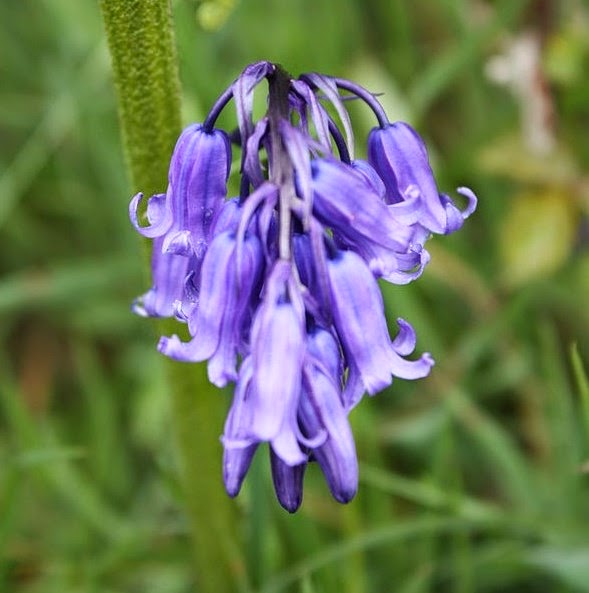
The gloriously scented bluebell


Easter is probably my favourite liturgical time of the year. At some point many years ago, I realised that a wonderful sense of wellbeing and enthusiasm comes over me at this time of year. It is also matched by the warming springtime, longer days, daffodils and bluebells. This sense of wellbeing arrives at Easter, and follows on from a quieter Lenten time of inner transformation and prayerfulness.


I do not think I have ever seen anything more beautiful than the bluebell I have been looking at. I know the beauty of our Lord by it.
Gerard Manley Hopkins


Lent has traditionally been a time of prayer, fasting and helping others (almsgiving), when we engage in a period of renewal, and try in our own way to echo the 40 days our Lord spent in the wilderness, praying, fasting, and being tempted. It culminates at Easter when we take time to meditate on His Passion, and to celebrate His Resurrection.


It is a time of cleansing and sacrifice, of doing without unnecessary luxuries and of consciously trying to give up unhealthy habits and behaviours. Some people decide to give up something specific such as smoking, alcohol, chocolate or sugar, or at least to limit their levels of consumption. Others look towards their actions and try to give up bad habits, negative attitudes, unhelpful thinking or other limiting behaviours. Still others decide to take up a positive habit for Lent – getting more exercise, eating well, helping others, showing random acts of kindness, or offering their time to volunteer at a local organisation.


What I noticed about this season is that even if we find ourselves too busy or too stressed or for any reason unable or uninterested to engage consciously with this renewal, the renewal seems to happen anyway, albeit with probably a little more resistance from ourselves. Life energy is renewing itself, and we all benefit. God, as Life, is emptying us out, clearing out the cobwebs, and preparing for a freshness in our direction, in our thinking, and in our lives. It prepares us for a new beginning. It is an internal time, a time of releasing old and unwanted habits. We are being renewed from within.


This inner renewal can be far from easy. It can be a time of intense frustration, where nothing goes according to plan, and obstacles appear around every corner. It is a time of following, rather than leading. It is a time of sensitivity, of recognising our limitations, our flaws and our compulsions. We can gain great self-awareness during this time, and become wise to our tendencies and habitual reactivity to life. We can also become weary and despairing. This weariness is a good thing, as it makes us reluctantly accept and admit our limitations. Through an inner consent and surrender, we are then more open to welcoming God’s Way into our lives and circumstances.


Fasting has been a tradition in many cultures and religions throughout the centuries, cleansing the body, clarifying the mind, and renewing our spirit. Apart from food, the act of going without can mean abstaining from overindulging in work life, sport, TV, computers, tablets, Facebook and other technology. It can also mean noticing and trying to balance or curb our emotional responses at work and with loved ones, such as losing our patience, getting angry, or falling into despair.


The difficulties we may experience during Lent humble us and make us more aware of our weaknesses and imbalances. Through perseverance and prayer, we are echoing the temptations of Jesus in the wilderness, his prayers to his Father, and his overcoming of the temptations in the desert. We can often feel that parts of us are dying off at this time of year. It is the dying off of the old stale parts of us. It stirs a desire in us for the purity and simplicity of God’s love. It awakens in us a desire for prayer and devotion. We gain patience for the weaknesses of others. We may even find it easier to help others at this time. Through sacrifice, our internal needs are simplified.


By Easter, there is a great forward thrust in life, in nature and within ourselves. The darkness of winter gives way to the light of spring. The land becomes warm, crops are sown and vegetables are planted for the seasons ahead. We notice the quality of light changing, the length of our day, and daylight saving heralds a burst of evening light and activity. We feel back to our old selves, but better, because humility stays with us, and we remain sensitive to others needs. We are more generous with our desires. We want something, but because it benefits more than just ourselves. This season surrounds us with a sense of holiness and goodwill and acceptance of self, others and our circumstances. We are blessed and renewed.


Image from Wikimedia Commons

Tuesday, 17 March 2015

St. Patrick


Hail, glorious Saint Patrick, dear saint of our Isle
On us thy poor children bestow a sweet smile
And now thou art high in thy mansions above
On Erin's green valleys, look down in thy love.


Today marks the feast day of Saint Patrick, the patron saint of Ireland. It is a celebration which is marked throughout the world, when the Shamrock is worn, and the Green is on display.

Much of St. Patrick's life is the stuff of legend, but there are two surviving letters written by him in Latin, which give an insight into his life and his character - the Confession/Declaration (Confessio) and the Letter to Coroticus which tell of his early years, his faith, and his missionary life in Ireland as a bishop.


Early Years
He was born into a Christian family in Britain in approximately 390 AD. The family were of the Roman official class and were materially comfortable. When he was 16, he was captured and brought to Ireland as a slave, where his own faith was strongly tested. Coming from such a comfortable background, he now faced life threatening situations, isolation and hardship. It was in this context, where he worked for some time as a shepherd and faced his despair and aloneness, that his prayer life deepened and his faith matured. He came to know that God was present.


My faith grew stronger and my zeal so intense that in the course of a single day I would say as many as a hundred prayers and almost as many in the night. This I did even when I was in the woods and on the mountains. Even in times of snow or frost or rain I would rise before dawn to pray.
St. Patrick, The Confession


After 6 years, he heard a voice telling him he would soon go home, and this prompted him to make an attempt to escape from his master. He fled 200 miles to the coast and was eventually allowed to board a trading ship bound for Europe. Enduring more hardship, hunger and captivity, he finally made it home to his family in Britain. Profoundly affected by his experience, he decided to further deepen his faith and knowledge by embarking on a period of study of Christianity. It is believed he studied primarily in France, and was ordained by St. Germanus of Auxerre. His writings show his great understanding of the Bible and his familiarity with the earliest Fathers of the Church.

Responding to another vision where he heard "the voice of the Irish" calling him to them, St. Patrick returned to Ireland in approximately 432 AD to help spread the Christian faith. He undoubtedly received much resistance initially and was again held captive at times, but The Confession depicts a time of great conversion when St. Patrick baptised thousands of people, and ordained many priests. He felt this was his true vocation, and was filled with enthusiasm and energy to share his faith with the people of Ireland.


Legends
Irish folklore tells how St. Patrick used the three leaves of the Shamrock plant to explain the Holy Trinity: the Father, the Son, and the Holy Spirit - three persons in one God. The Shamrock remains an important symbol of St. Patrick and Ireland to this day.

Legend also tells how St. Patrick banished the snakes from the island, chasing them into the sea with his staff after they assailed him during a 40-day fast he was undertaking on top of a hill. This may be more symbolic than literal, associating St. Patrick with driving out the old, pagan ways out of Ireland and heralding in a new faith. It is also believed that it was more a merging of the valuable old Irish traditional and cultural beliefs with his teaching which moved forward into this new Christian faith.

Another tale describes whenever Patrick was teaching about Christianity, he would thrust his ash walking stick into the ground. On one spot at Aspatria (ash of Patrick), it is told that it took a long time to convince the people, that his ash stick had taken root before he had firmly planted his message. 


Later Years
After nearly thirty years of Evangelism, he died on 17 March 461, and according to tradition, was buried at Downpatrick. His life as a missionary was very successful. He endured constant danger, threats and further times of captivity, but saw "the flock of the Lord in Ireland growing splendidly with the greatest care" (The Confession). He had a deep knowing that God was working through him, guiding and protecting him, and this made him trust completely in his mission without worry for his safety. He had a love and belief in his vocation, and he offers an example to us of a grace-filled life. Patrick has endured as the principal champion of Irish Christianity and is held in great esteem in the Irish Church, and in the hearts of the Irish people. Relics of St. Patrick, including his Bell, are held at the National Museum of Ireland.

As a cultural day, St. Patricks Day is celebrated by the Irish and any other enthusiastic nationality wishing to don the Green for the day. Parades are being held in the major cities across the world, wherever the Irish have replanted themselves over many past generations. From the days of the famine in the 1840s, millions of Irish either chose or were forced to survive elsewhere in the world, bringing their Irishness with them, and hopefully managing to embody it as they welcomed the new cultures of their chosen destinations. On this day, we send our love to our friends and family overseas, we wear our Shamrock, we cheer at our parades, and we count our blessings for each other.


Beannachtaí na Féile Pádraig oraibh!


Image of St. Patrick, courtesy of Wikimedia Commons

Sunday, 8 March 2015

Going Beyond The Shadows


Beyond The Shadows


There are times when we fight with shadows that don’t even exist. Then, there are times when we shock ourselves by the darker sides of our nature. We see that we contain openness and closed-mindedness and closed-heartedness. We contain dark and light, love and hate, peace and rage, acceptance and rebellion, hope and despair, success and defeat, approval and rejection. It seems the deeper we go into one polarity, the wider we can also swing in its equivalent polarity. We prefer the "nicer" places, and try and avoid the "darker" places.

We all have unloving qualities. We can rage against the flow of our lives. We can criticise others' weaknesses and interpret how they further complicate and frustrate our lives. We can blame Life and God for our difficulties and in spite of that, find no relief. We can move through our days and not once get beyond ourselves, our needs and demands. In spite of being dedicated to self-awareness, we lose control of our objectivity, we lose our patience, we get angry, we feel self-righteous or ashamed. Can we get over ourselves!

As we lapse in our Contemplative practices, our meditation, our awareness of Silence, our gaze and consent to Spirit, we land into the shadows, into upheaval, disharmony and chaos. It is inevitable. Restlessness is the natural way of our mind and emotions. We won't change this reality. Contemplation gently reminds us again to take the focus off ourselves and the events of our ever-changing lives, to widen our gaze, and plant it on Presence, on Stillness, on Silence, on Spirit, on whatever or however God is manifesting in our lives.

The shadows remind us we have become compromised. They help tire us again of our restlessness and self-centredness, and return our hunger for balance and harmony. They remind us not to settle for anything less than awareness and trust in the higher order playing out in our lives.

We are multi-flawed human beings, with plenty of shadows. Humility and surrender allow us to admit them, to admit our forgetfulness and our lapses, and to seek forgiveness from ourselves and our loved ones who witness our flaws up close. Circumstances not going our way mostly reveal that our way is insufficient and incomplete, and perhaps not loving to everyone concerned, and would therefore not serve us well, either. We are softened and emptied out even more, ever more.


The way of Love and Harmony will always win out, and we end up being thankful this is the case. It's never about us. It's always about how Love is unravelling itself in us.


When our attention is on ourselves, in the image-blindness of the ego, everything is a distraction from God. When attention is in God, with the vision of faith, everything reveals God to us.
Laurence Freeman OSB, The Selfless Self


Thursday, 26 February 2015

Lead Kindly Light


Stained Glass at Mount Melleray Abbey


The Pillar of the Cloud

Lead, Kindly Light, amid the encircling gloom; Lead Thou me on.
The night is dark, and I am far from home; Lead Thou me on. 
Keep Thou my feet; I do not ask to see the distant scene; 
one step enough for me. 


I was not ever thus, nor pray'd that Thou shouldst lead me on; 
I loved to choose and see my path, but now lead Thou me on.
I loved the garish day, and, spite of fears, pride ruled my will: 
remember not past years. 


So long Your power hath blest me, sure it still will lead me on, 
o'er moor and fen, o'er crag and torrent, till the night is gone; 
and with the morn those angel faces smile 
which I have loved long since, and lost awhile.

John Henry Newman, at sea, 16th June 1833
Lenten Compline Hymn, Mount Melleray Abbey


I was very blessed to join in a prayerful retreat at Mount Melleray Abbey, near Cappoquin, where the above hymn was sung by the monks at the Compline office (evening prayer). It was composed by John Henry Newman in a period of turmoil, as he struggled to get home to England from Europe, and to pursue an inner pull to transform the Church. He endured loneliness, illness and a deep yearning to begin his quest, though he did not yet know what truly lay ahead for him.

I am in great gratitude for the presence of these inspiring Cistercian monks, who honour and live out their devotion to God, Love, Silence, Community and Contemplation, and allow us to join in and anchor ourselves there too. We know not what lies ahead for us, but by anchoring ourselves in the strength of our prayers, our deep inner knowing, and Silence, we invite and embody Rest.


Wednesday, 18 February 2015

Retreat


If the Cross is deeply contemplated, it is saying that love is supreme, and that the darkness and the apparent unfairness of life can be endured. In the Cross, love is able to speak ... speak to any human situation, whether of loss, of persecution, of disillusion.
Fr. John Woolley


As we begin the Lenten season, it reminds me again to look within, to recognise those unhelpful hiding places and defensive positions, those habitual reactions to others and to life, and to seek Love's comfort, Love's help, Love's understanding, Love's patience, Love's company, Love's solitude, Love's resilience, Love's invitation to surrender and overcome, Love's rest


Friday, 13 February 2015

Silence


God's poet is silence! His song is unspoken 
And yet so profound, and so loud, and so far,
That it thrills you and fills you in measures unbroken -
The unceasing song of the first morning star ....
Joaquin Miller, The True Poet


There was a beautiful calmness this week, a gentle invitation for the Spirit into Silence. It was restful, with a grateful recognition of peace, simplicity and community. And then, typically, a familiar moment of turmoil arrived, with its not-so-welcome recognition of panic, confusion and isolation. It amazes me how our default polarities sit so closely together, pulling us from one extreme to the other.

The spiritual masters, saints and mystics have recommended for hundreds and thousands of years, that we consciously place our attention on Silence and Presence, rather than on the story or object of our disharmony; focus on the Presence rather than on the circumstances of the turmoil; focus on the background Silence in which this is all taking place. In this way, the circumstances are acknowledged, allowed and absorbed into the entire background, rather than so dominating our foreground that we cannot even sense Silence as the background.

This is a practice of prioritising Presence over the restless, ever-changing, often weary landscape of our minds. It is the repetitive action of placing our attention on God, on Silence, like the hall light we leave on through the night while we sleep. Ramana Maharshi tells us to concentrate on the light, rather than on what is illuminated by the light. This is our permanent landing place. This is certainly one reminder I constantly use, and somehow, I recognise my true Self there, in recognising God, and an ease comes to the Spirit.


In the attitude of silence the soul finds the path in a clearer light, and what is elusive and deceptive resolves itself into crystal clearness. Our life is a long and arduous quest after Truth.
Mahatma Gandhi


Silence, as Presence, as Beingness, is the background which holds all else, and into which everything is absorbed and dissolves. It is Silence in the presence of turmoil, peace, fear, frustration, joy, disappointment and inconsistency. It is Silence in spite of noise, interruption, disharmony, joy, progression, success. It is the Silence within which our inner knowing is revealed.

In an attitude of trust and silence, we bow everything to God. Contemplation confirms that a higher order of balance and harmony is working its way out in us and in Life itself. These moments of turmoil take us beyond Resilience. We just need to keep our eye on the light, and watch it continue to shine forth in and around us.


Returning to silence is returning to peace.
Returning to peace, the world reharmonises itself.
Lao Tzu